

5 Productive Uses of Waiting Time

5 Productive Uses of Waiting Time

September 1, 2024

Joel 4 reduced

By Joel Morgan

Welcome to Time Diamonds!  This week, we discuss ways to turn waiting time into productive time.

If you joined our previous conversation TAKE 4 Steps to Arrive On Time, Every Time, you know that the discipline of consistently arriving on time will often result in your spending time waiting for someone else.  While it’s easy to see this waiting time as wasted time, there are numerous ways that you can squeeze a lot of value out of that waiting time.  Here are a few ideas:

1. Catch up on social media

In our previous discussion about Positive IDA (Immediate Decisive Action), we looked at the 2010 Basex study describing the loss of productivity from electronic distractions.  Each distraction, say, a “quick check of Facebook”, can result in up to 20 minutes lost as we struggle to return to the original activity.

For many of us, though, checking social media is enjoyably entertaining and a valuable way to keep up with the life events of friends and family.  If social media use is important to you, nothing wrong with that!

Instead of allowing social media use to distract you from other, arguably more important life events like work and actual face-to-face interaction, save it for your waiting time!  Waiting for the meeting to start?  Waiting for the person you’re meeting to show up?  Catch up on your social media activity while you wait!  In fact, this social media time can be a great psychological reward for the effort you’ve made to arrive early (and have waiting time) in the first place.

2. Learn something new

Many of us would like to learn something new, whether it’s an additional skill to enhance your career, or just a hobby you’d like to explore. Use your waiting time to add that new knowledge you’re looking for!

There are many great online learning resources available today.  One free option is Khan Academy.  While Khan Academy is best known as a resource for younger students, it can still offer amazing value if you’re an adult looking to brush up on knowledge you’ve forgotten (calculus, for example) or taking your first steps through the basics of a new subject (programming, economics, chemistry, etc).

Another great web learning resource is Udemy.  Udemy courses, which typically cost $10 – $15 each, consist of a series of pre-recorded videos created by anyone who has something to teach.  The video format can be especially helpful if you find that you’re someone who doesn’t learn well from text.

Udemy courses cover an extremely broad range of subjects, from programming languages to yoga to violin lessons!  Once you buy a course, it’s available to you “for life”, so you can take it at whatever pace you want for as long as you want.

Because Khan Academy, Udemy, and other similar services are “go at your own pace”, they’re perfect for waiting time!  Got 10 minutes before your appointment?  Pull up the next lesson and learn something new!

3. Read interesting articles

Where in the world is Tuvalu?  I asked myself this question recently when I learned that the “.tv” internet domain is actually owned by the Pacific island nation of Tuvalu!

Possessing unending curiosity can be both a blessing and a curse.  The blessing comes in the form of constant learning leading to greater understanding. At the same time, the constant curiosity can cause productivity-reducing interruptions (see previous conversation about Positive IDA) due to our desire to answer questions immediately.

Is there a “curiosity question” that you’re just dying to answer?  Instead of interrupting whatever you’re doing at the moment (which is often more important than the “burning question”), make a list of these questions (a mobile “notepad” app is perfect for this list), then plunge into them when you’re waiting for an appointment or meeting!

4. Read a book

Continuing the “reading” theme here, waiting time is a great opportunity to read a book!  If you’ve adopted (or are willing to try) e-books, this can be an especially great option.  With e-books, you can carry your entire library around with you in your mobile device, available at a moment’s notice when you find that you have waiting time!

While Amazon’s Kindle helped pave the way for e-books, there are other options available.  For example, the OverDrive e-book app allows you to borrow e-books from the library!  And Barnes & Noble’s Nook e-book resource offers an alternative to the Amazon Kindle service.

One of the best things about e-books is that you can buy / borrow and read them on your existing mobile device or even on your laptop / desktop computer!  You don’t actually have to buy a Kindle or Nook to take advantage of e-book offerings Amazon and Barnes & Noble.  You can simply buy the book and read it on your mobile device.

As with social media scrolling, your reading time can become a reward for the effort you made to arrive on time.  Can’t wait to find out what happens next to your favorite character in the book?  Make sure you have that next chapter ready for your waiting time.  You may even be glad you had to wait!

5. Catch up / clean up email

Email, even “important” work-related email, can become one of our biggest time-wasters. A 2012 study by The Universiy of California at Irvine and the U.S. Army found that our “always on” email habits at work significantly reduce productivity and significantly increase stress.   A related 2014 study conducted by the University of British Columbia found that a few scheduled email-management times over the course of a day reduce stress and increase productivity.

As part of establishing new habits when it comes to email, waiting time offers a great opportunity to catch up and clean up your email box! Even if you’re not able to take your work email with you through a mobile device, you can still catch up personal email during waiting time.  Also, depending on your company’s email policies, you may be able to forward critical (or lengthy) work emails to your personal email box to read and consider during your waiting time.

And if you haven’t already established an effective folder system for your email box, waiting time can be a great time to get that started!  Like storage boxes at home, email folders make a great place to store emails that you’ve already seen but aren’t ready to throw away. 

When you find yourself with waiting time, check your emails, respond to the ones that need responses, then stash them in your email storage boxes and relieve the clutter in your in-box!

Turn Waiting Time Into Treasure Well-Spent!

Every moment of your life is a treasure.  There’s no need to feel that waiting time is wasted treasure.  Convert that waiting time to treasure well spent!

Got any other tips that might help the Time Diamonds community?  We’d love to hear from you!  Please leave your ideas in the comments below!

The Power of Positive IDA

The Power of Positive IDA

September 8, 2024

Joel 4 reduced

By Joel Morgan

Welcome to Time Diamonds!  In this week’s “new day’s resolution” conversation, we take a step closer to the lives we want to lead by tapping into The Power of Positive IDA (Immediate Decisive Action)!

Before we discuss the power of positive IDA, let’s take a look at negative IDA.  Whereas positive IDA means “Immediate Decisive Action”, negative IDA means “I wish IDA done it”!

Thank you, yes, I did create the illustration; no applause necessary.  😛

Not very attractive, right?  And the results of falling prey to negative IDA aren’t very attractive either.

The Impact of Negative IDA

Negative IDA takes two possible forms in our lives – 1) fear of taking a step that want to take, or 2) habitually postponing important actions, a.k.a., procrastinating!

Australian palliative care nurse Bronnie Ware published a book in 2012 called “The Top Five Regrets of the Dying”.  In her book, Ware summarizes the dying epiphanies of her many patients over the final weeks of their lives.  As you can see from her list below, some of these regrets arise from the negative IDA of fear, while others are the result of procrastination:

  1. I wish I’d had the courage to live a life true to myself, not the life others expected of me. (fear)
  2. I wish I hadn’t worked so hard. (fear and procrastination)
  3. I wish I’d had the courage to express my feelings. (fear)
  4. I wish I had stayed in touch with my friends. (procrastination)
  5. I wish that I had let myself be happier. (fear and procrastination)

The Personal Cost of Negative IDA

The negative IDA of fear convinces us that the potential (and usually unknown) consequences of taking a certain action will be worse than the consequences of not taking that action. When it came to living true to themselves, Ware’s patients looked back on their lives with regret at having succumbed to the negative IDA of fear.

The negative IDA of procrastination tells us that we’re somehow better off postponing an action until another time in favor of something that may be more urgent (but is probably simply easier) than the action that we’re postponing. Certainly, none of us would suggest that it’s a good idea to postpone important actions indefinitely (or even permanently), but we still allow negative IDA to convince to do so anyway!

The Financial Cost of Negative IDA

While the negative IDA of fear typically carries a personal happiness cost, the negative IDA of procrastination can also carry a financial cost.  According to a 2010 study (admittedly, somewhat dated now) published by Basex, a U.S. knowledge economy research firm, knowledge workers in the U.S. in 2010 wasted approximately 25 percent of their time dealing with information overload in the form of the incessant stream of data that bombards each of us every day. 

The Basex study estimated that the distraction of information overload cost the U.S. economy a staggering $997 BILLION in reduced productivity and innovation in 2010.  And while the Basex study covered only the U.S., it’s not a stretch to believe that information workers in the rest of the world suffered the same level of distraction as well.

If the high-level national cost of procrastination due to information overload doesn’t give you pause for thought, a much more personal point might.  A 2009 study conducted by Gloria Mark, a University of California, Irvine professor in the department of informatics, found that employees typically focus on a task for approximately three minutes before tending to email, social media, or their smartphone. It takes 20 minutes to return to the original task following such a distraction.

Just let that sink in for a moment. Three minutes of work, followed by checking email, text, or IM, followed by a 20-minute lag before we’re able to return focus properly to the action we really needed to take in the first place!

So, how can we eliminate the power of negative IDA in our lives?

Tapping Into the Power of Positive IDA

By the way, for anyone interested in owning one of my stunningly artistic IDA graphics, send me a message through the “Contact” page and I’ll happily send you your very own pair of IDA prints. 😀

Positive IDA stands for “Immediate Decisive Action”.  In other words, what action can you take right now, this moment, that will represent a significant step toward the life that you truly want to lead?

Let’s take Bronnie Ware’s list of negative IDA’s from the deathbed revelations of her patients and turn those into positive IDA’s.  That positive IDA list might then look like this –

  1. What IDA can I take right now to restore self-truth to my life choices instead of making the choices others expect of me? Explore a change to the career I wanted? Sign up for music lessons? A simple but meaningful change of wardrobe?
  2. What IDA can I take right now to restore better work-life balance? Eliminate an information overload distraction that reduces my work efficiency, forcing me to spend more hours getting my job done? Reduce / eliminate an expense that requires higher income (and, ostensibly, more work hours)? Explore a career change?
  3. What IDA can I take right now to conquer my fear of expressing myself? Contact someone with whom I’ve had a falling out to express my feelings?  Or, on the positive side, contact a friend or family member out of the blue to express my appreciation for him or her?
  4. What IDA can I take right now to restore connection with an old friend? Pick up the phone and call? Try to find him/her in social media? Schedule a meal or other activity together?
  5. What IDA can I take right now to let myself be happier? Make an intentional choice right now to move on from the pain of an old insult, loss, or other personal injury? Turn off the news? Stop reading user comments in social media?

The Power of Taking One Step

The list above represents possible first steps.  And, amazingly, taking a single step toward an important goal or task can often be the one single thing we need to break through the grip of negative IDA and complete that goal or task.

Psychologist Dr. Jeremy Dean, in his blog, Psyblog, describes the power of “the Zeigarnik effect”, named after 20th-century Russian psychologist, Bluma Zeigarnik.  

Zeignarnik had observed that we seem to be much more likely to remember tasks if we’ve at least begun them, regardless of where we are in the arc of completion. She conducted experiments in the 1920s in which participants were asked to perform small tasks in her lab, such as assembling puzzles or stringing beads. When asked later to describe their activities, participants were much more likely to remember tasks left unfinished than those that had already been completed. 

The ultimate importance to us of these experiments?  Taking one step, any step, is very likely to lead to another step.  Putting it another way, the distance from step 1 to step 2 is shorter than the distance from step 0 to step 1.  All we have to do is take step 1!

The “Dash” Method

So, what are some possible strategies for taking that first step?

In his 43 Folders productivity blog, Merlin Mann describes a procrastination-beating tactic called a “dash”, which he describes as “a short burst of focused activity during which you force yourself to do nothing but work on the procrastinated item for a very short period of time—perhaps as little as just one minute.” 

In other words, you’re setting yourself a goal that is ridiculously easy to accomplish, so you don’t need to make any sort of grand weighty commitment to “get it knocked out”. You just do it without even necessarily having to “block off time” for it. But that “dash” still provides you with the psychological boost of knowing that you’ve at least taken that critical first step.  You’ve started on the task.

Coupling Mann’s approach with the Zeigarnik effect suggests that after we’ve taken that ridiculously easy first “dash” step, we are then MUCH more likely to take the next step after that.  And then the next.  And then the next.  And suddenly, we find that the task is complete!  The power of positive IDA!

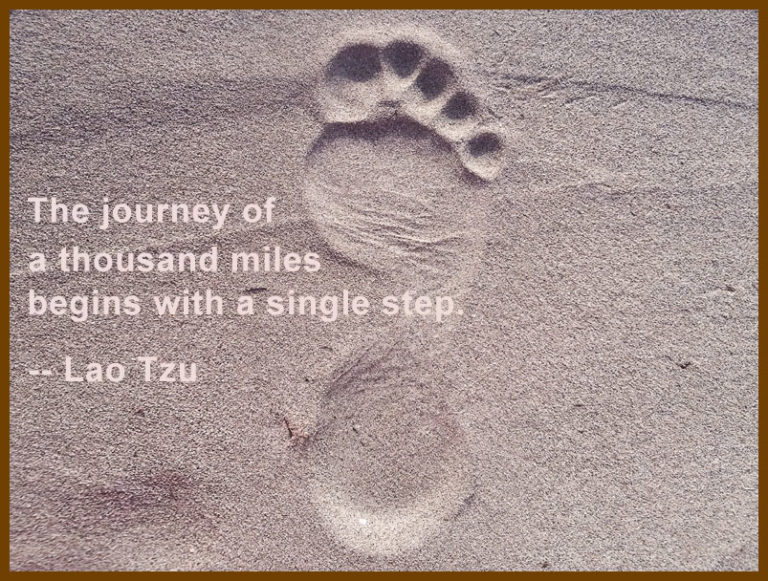
Ancient Chinese philosopher Lao Tzu also recognized the power of positive IDA, as he expressed in this teaching:  “The journey of a thousand miles begins with a single step”.

What’s Your IDA For Today?

In conclusion, I challenge you to choose your IDA for today and do it!  Maybe it’s taking five minutes to explore that career change you want to make.  Maybe it’s one minute of stretching exercises right next to your desk (the first step toward better fitness!).  Maybe it’s 10 minutes of trying to find the contact information for that dear friend that you never wanted to lose touch with.

Tap into the power of positive IDA.  Choose your Immediate Decisive Action and do it today!

TAKE 4 Steps To Arrive On Time, Every Time

TAKE 4 Steps To Arrive On Time, Every Time

September 15, 2024

Joel 4 reduced

By Joel Morgan

Hi!  I’m Joel Morgan.  Welcome to Time Diamonds!

This is a time that a significant portion of the planet recognizes the start of a new year.  And many of us like to make “new year’s resolutions”, life changes we plan to make in the new year.  To follow along with that concept, for the next few weeks our conversations on Time Diamonds will focus on “new day’s resolutions”, life changes that we can make starting with each new day!

Our first “new day’s resolution” conversation for the new year, then, focuses on punctuality, the habit of arriving on time, every time.  I chose this conversation first because I spent the first 30 years of my life habitually arriving late! I know that many of us across the world struggle with the problem of tardiness, but I feel pretty confident that I was the world’s worst!

After years of trying numerous different failing strategies (who else out there has tried the “set my clock forward 10 minutes” trick?), I finally just sort of stumbled into the solution.  No light-bulb moments here.  I think the solution was just so painfully obvious and easy that I just repeatedly overlooked it. 

I was so excited about how well this strategy worked for me that, of course, I wanted to share it with everyone else struggling with the same problem. I considered writing a book on the subject. But when I sat down to start outlining that book, I realized that the concept is so simple that I couldn’t fill a chapter, much less an entire book!

So, here, then, are my “TAKE” 4 steps to arriving on time every time:

1. Treasure time – yours and everyone else’s

2. A pre-agreed time is a commitment

3. Know and do ONLY the truly necessary pre-departure steps

4. Estimate time pessimistically

Now, let’s dig into what these steps mean.

1. Treasure time – yours and everyone else’s

The first step to arriving on time every time is simply seeing time as treasure.  And that means not only your time, but everyone else’s time, too.  And more to the point for today’s conversation, the time of anyone to whom you have made a time commitment.

With each new day that we wake up blessed with another day of precious life, we receive a treasure chest full of the treasure of time, ours to spend as we choose.  And every single one of us gets the same amount of that treasure for that day, regardless of race, age, gender, economic status, or any other demographic factor.  The treasure of time doesn’t discriminate.  We each get exactly the same amount each day.

In future conversations, we’ll dig into how we spend out our time treasure and how we can go about spending more of it on what we choose.  The point for today is that time is treasure.  

TAKE step 1.  Value the time treasure you have.  And value everyone else’s, too.

2. A pre-agreed time is a commitment

The second step to arriving on time every time is understanding that a pre-agreed time is a commitment.  When you choose to do an activity with someone else, and agree on a time to do that activity, whether it be a job, a class, a doctor’s appointment, or a lunch meeting, your agreement on a certain time has created a commitment, an expectation in the mind of someone else that you will, in fact, be there at the time you said.

Our lives are full of commitments that are quite serious. Work commitments, school commitments, marriage / partnership commitments, community service commitments, and the list goes on. Each kind of commitment carries its own degree of consequences for are not keeping that commitment. The consequences, for example, of not showing up for a court appearance, can be quite severe. By comparison, a more leisurely commitment, like meeting for lunch, carries a substantially lighter consequence for failure.

Due to lighter consequences, more leisurely personal commitments can sometimes seem “optional”.  And yet, when you agree to a time, the expectation is exactly the same for each type of commitment, regardless of consequences.  If I say, “I will meet you at 1:30”, I’ve created an expectation in your mind. I’ve said it and you should be able to rely on what I’ve said. 

TAKE step 2.  Time is treasure, and when you agree to spend it at a certain time with someone else, you have made a commitment.

3. Know and do ONLY the truly necessary pre-departure steps

Now that we have explored the philosophy behind the importance of arriving on time, we can get into the true nuts-and-bolts of exactly how to make it happen.  Remember when I said that the plan was painfully obvious and easy?  Now you get to find out why!

Simply put, when you’ve made a time commitment, list out the tasks you must do to prepare for that time commitment, then do only those tasks!  Obvious, right?

To arrive at your list of “must-do” tasks, you have to start by listing everything you do currently. For example, suppose you work a job where your workday starts at 8 AM (this one was quite possibly the worst challenge for me). Which tasks do you perform habitually before you go do your job?

Well, first, you probably get out of bed. What else beyond that? Do you eat breakfast? Do you bathe? Do you pick out the clothes you’ll wear to work?

How about other less obvious tasks that you habitually perform before you go to work? For example, letting your car warm up for 10 minutes, walking to catch a bus somewhere, checking to make sure your home is secure for the day while you’re gone? This list will vary for each individual. The important point for now is to list out everything you do habitually before you go do your job.

While you’re making this list, you have to be extremely honest with yourself and include all tasks you perform, even if only occasionally, before starting work. Do you check your email? Scroll social media on your phone? Turn on the TV to catch a weather report or other programming?  You can only start creating a future punctuality habit if you’re willing to be honest with yourself about every single task you do today. There’s no shame in listing these items out for yourself, and you’ll only be cheating yourself if you don’t.

Now, go back and review your list, picking out only those tasks that you truly must do before you leave for work. Throw out everything else. For example, scrolling social media. Is that something you MUST do before leaving, or could you possibly do that on your lunch break or at the end of the work day?

Now that you’ve made your list of tasks that are absolutely necessary before you leave for work, and thrown out those things that aren’t absolutely necessary, go back through your list one more time. Of those things you have listed as being absolutely necessary, are there any of them that you could do at a different time?  For example, picking out your clothes for work.  Is that something you could do the night before?

And now that you are absolutely, positively sure you have narrowed your list down to only those items that you must do before you leave for work, put that list somewhere where you’ll see it the night before and/or first thing in the morning. Tape it to your bathroom mirror. Stick a copy under your alarm clock. Keep a digital copy in your phone. Whatever method you choose, make sure you put the list right in your way where you can’t miss it. 

TAKE step 3. Make that list and stick to it!

4. Estimate time pessimistically

4. Estimate time pessimistically

Now that you’ve made your list, it’s time to assign an estimated completion time to each item on that list.  You can then use the total of those estimated times to calculate your “start getting ready” time.

You’ll find throughout our conversations in Time Diamonds that I am a very optimistic person. I almost always recommend optimism as a foundation mindset when attacking any kind of problem in life. But calculating your task times is one major exception where you must always estimate pessimistically.

Estimating pessimistically simply means that instead of assuming you’ll be able to perform each necessary task in the “best case” least amount of time possible, you must assume that unforeseen circumstances will result in task times taking longer than the best-case scenario.

For example, suppose you’ve identified that you must eat breakfast before leaving for work in the morning. Furthermore, assume that, best case, it’s possible for you to prepare and eat your breakfast in 15 minutes. So, you may be tempted to allocate 15 minutes for your breakfast in your task time calculation.

Instead, you must assume that each task will take longer than expected. In my experience, 50% is a good safe “padding” to add to the estimated time for each task. Back to our breakfast example, while it may be possible for you to have your breakfast in 15 minutes, you should add 50% to that estimate. 50% (or half) of 15 is 7.5. Adding that 7.5 to your original 15, you have 22.5 minutes (which you could just round up to 23).

Adding this 50% padding allows for unforeseen circumstances. For instance, what if it’s time to eat your breakfast and you find that you don’t have the supplies you need? If you had planned to have a piece of toast, for example, but you are out of bread, you’ll need to substitute some other equivalent food item instead.  That adjustment will take time, which you must allow for in your padding.

When it comes to travel times, I would go even further and add 100% padding. For example, if you’ve found that your commute to work by train can take as little as 45 minutes, you may be tempted to use that best-case 45 minutes as your travel time estimate.  Instead, you should add 100%, or another 45 minutes, to that estimate for a total of 90 minutes.

I know the 100% travel padding sounds ridiculous at first, but travel is one of the tasks that you often have the least control over and is prone to the most extreme “unforeseen circumstances” (traffic jams, for instance). I still recommend that you start with 100% travel padding.  Your experience over time may allow you to start reducing that amount of padding to something more reasonable.  

Now that you have listed your necessary pre-departure tasks and estimated the time for each task, you can add the tasks times together to arrive at the grand total amount of time you need to allow for preparation.  Subtract that total amount of time from the arrival time to which you have committed, and you’ll then have the time at which you need to start preparing.

I know the self-discipline of making this list and calculating times may feel very mechanical and forced at first. But you’ll feel an extremely gratifying reward for your efforts, though, when you find that you are consistently arriving on time for every single commitment you make. As that habit takes hold in your life, others will begin noticing that you arrive on time every time.  And eventually, the punctuality habit will become so deeply ingrained in your mind that you don’t need lists at all. You’ll automatically and instinctively know what you need to do and when in order to arrive on time every time!

TAKE step 4.  Estimate your time pessimistically!

In closing, here are those four steps again:

1. Treasure time – yours and everyone else’s

2. A pre-agreed time is a commitment

3. Know and do ONLY the truly necessary pre-departure steps

4. Estimate time pessimistically

You can TAKE every single one of these steps today and start arriving on time every time!